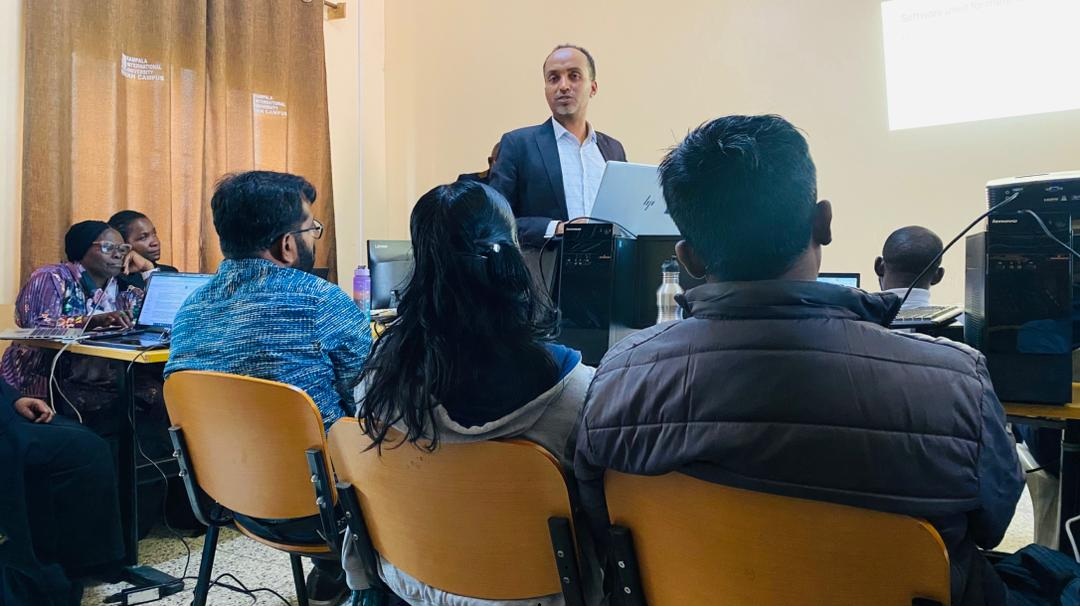
KIU, Western Campus – As part of its commitment to research that drives impact and shapes evidence-based practice, on Thursday, April 16, 2026, Kampala International University, Western Campus (KIU-WC), through the Directorate of Research, Innovation, Consultancy, and Extension (DRICE) and the Directorate of Higher Degrees and Research (DHDR), in collaboration with the School of Pharmacy, hosted a hands-on training on Systematic Review and Meta-Analysis for academic staff and postgraduate students.
Officially launching the training, Prof. Patrick Aja Maduabuchi, Director of RICE, reminded participants that research demands continuous growth. “In academics, we keep on learning new skills even if you are a professor,” he said.
He urged postgraduate students to prioritize systematic reviews early in their research journey, noting the scope could be regional, national, or global. Prof. Aja also emphasized that systematic reviews are collaborative efforts, best done in groups where expertise is shared and bias is reduced.
Dr. Victor Fasogbon Ilemobayo from the Biochemistry Department led participants through Understanding Systematic Review: definitions, history, and types, plus the key steps involved in conducting one. “A systematic review is a methodical approach to answering focused research questions using narrow, pre-defined parameters,” he explained.
Dr. Ilemobayo noted that the structured approach reduces bias and makes the findings trustworthy for healthcare decisions. He later walked the group through the core stages: framing the research question, setting inclusion criteria, systematic searching, study selection, quality appraisal, and data extraction.
Dr. Serawit Deyno Chorito, Senior Lecturer of Pharmacology, led a hands-on session on Search Strategy and Meta-Analysis. “The quality of your review depends on the quality of your search,” he said, warning that missing key studies at the search stage leads to incomplete conclusions.
During the session, Dr. Chorito demonstrated building effective strategies using PubMed, Scopus, and Google Scholar with Boolean operators and MeSH terms to refine results. He then introduced meta-analysis, showing how to pool data from multiple studies, interpret forest plots, assess heterogeneity, and evaluate publication bias.
The one-day training reinforced KIU’s drive to strengthen research capacity within the School of Pharmacy. By combining expert instruction with practical exercises, the session equipped attendees with skills to produce high-quality reviews that can inform policy, clinical practice, and further research.
The event closed with a call for participants to form research clusters and initiate collaborative systematic review projects within the School.