Sep
KIU Hosts Microsoft African Development Center Training on Empowering Africa Through Innovation
September 26, 2023, 6:18 pm
 Administrator
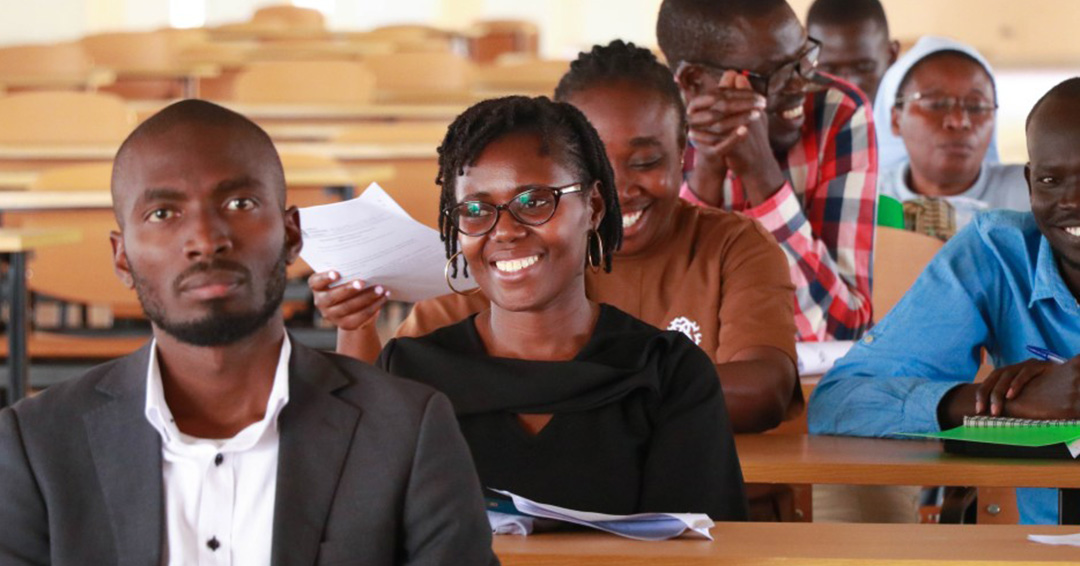
KIU, Western Campus — Kampala International University, Western Campus (KIU-WC) through its Directorate of Research, Innovation, Consultancy and Extension (DRICE), successfully concluded a two-day intensive training on Computer-Aided Drug Development (CADD) Module I, equipping researchers, lecturers, postgraduate students and scientists with advanced computational skills for modern drug discovery.
Held from July 9th – 10th, 2026, the virtual training formed part of the Bioinformatics and Computational Biology Training Series – 2026, bringing together participants from various institutions for expert-led lectures, practical demonstrations and hands-on laboratory sessions designed to strengthen research capacity in computational drug discovery.
Opening the programme, Prof. Patrick Aja Maduabuchi, Director of RICE underscored the growing role of computational approaches in transforming pharmaceutical research by accelerating drug discovery, reducing research costs and improving the efficiency of developing new therapeutic agents. He encouraged participants to fully engage with the facilitators and apply the acquired knowledge to address real-world biomedical research challenges.
The first day focused on laying the foundations of CADD, with Dr. Peter Chinedu Agu from the College of Pharmaceutical Sciences, Southwest University, Chongqing, China introducing participants to the modern drug discovery pipeline, demonstrating how computational techniques have revolutionised pharmaceutical research by enabling the rapid identification and optimisation of potential drug candidates.
Participants also explored internationally recognised chemical databases, including PubChem, ChEMBL and ZINC, learning how to retrieve and evaluate chemical compounds relevant to drug discovery. A practical session on molecular structure drawing using ChemSketch further equipped participants with essential skills in ligand preparation and molecular visualisation.
Complementing these sessions, Dr. Victor Fasogbon Ilemobayo from the Biochemistry Department at KIU-WC delivered presentations on molecular descriptors, physicochemical properties, pharmacokinetics, pharmacodynamics and the principles of drug-likeness, with particular emphasis on Lipinski’s Rule of Five. During the practical component, participants gained hands-on experience using SwissADME, AdmetLab 3 and ProTox-3.0 to predict pharmacokinetic properties, toxicity and drug-likeness of potential therapeutic compounds.
The opening day concluded with an interactive discussion moderated by Dr. Agu, providing participants with an opportunity to clarify concepts and explore practical applications of CADD in biomedical research.
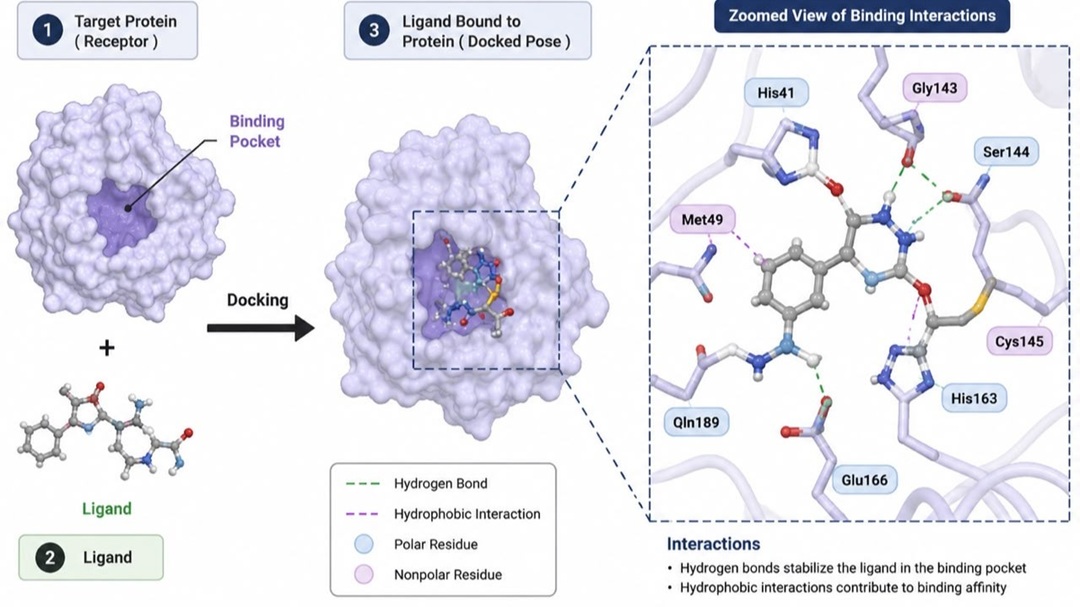
Building on these fundamentals, the second day began with a recap of key concepts from the previous sessions before Dr. Naveez Muhammed from Vellore Institute of Technology, India introduced participants to protein targets, binding pocket prediction and target identification, highlighting the critical role proteins play in rational drug discovery. Participants were introduced to key bioinformatics resources, including UniProt, the Protein Data Bank (PDB) and Swiss Target Prediction, which are widely used for identifying and validating therapeutic targets.
Dr. Ilemobayo later guided participants through practical sessions involving protein structure retrieval from UniProt and PDB, interpretation of protein structural information, assessment of protein quality based on experimental methods and resolution, as well as the use of AlphaFold for exploring predicted three-dimensional protein structures suitable for molecular docking studies.
Participants also received practical training in binding site analysis using computational platforms such as CASTp, Protein Plus, DoGSiteScorer and Discovery Studio Visualizer, where they learned to identify ligand-binding pockets, analyse amino acid residues and prepare receptor structures for molecular docking.
The training further explored protein structure prediction and homology modelling. Dr. Ilemobayo introduced participants to the theoretical principles of template selection, model validation and quality assessment before demonstrating the use of Swiss Model to generate reliable three-dimensional protein structures. Participants subsequently validated their models using QMEAN, Ramachandran plots, Verify3D and ERRAT, essential tools for ensuring structural reliability before downstream computational analyses.
Beyond the scheduled sessions, the training was characterised by lively scientific discussions that allowed participants to engage directly with facilitators on emerging areas such as molecular docking, protein engineering, molecular dynamics simulations, nanomedicine, biologics and the growing application of artificial intelligence in pharmaceutical research.
Closing the programme, Prof. Maduabuchi commended participants for their commitment and active engagement throughout the training, reaffirming KIU’s commitment to strengthening research capacity in bioinformatics and computational biology across Africa through continuous professional development initiatives.
The organising committee announced that participants will receive practical training manuals, software installation guides, certificates of participation and continued mentorship through dedicated WhatsApp platforms. Participants were also encouraged to initiate independent computational drug discovery projects under the guidance of the programme facilitators.
The successful completion of CADD Module I marks another significant milestone in KIU’s efforts to promote excellence in biomedical research and innovation. By combining expert instruction with intensive practical training, the programme equipped participants with globally relevant computational skills that will strengthen drug discovery research, foster interdisciplinary collaboration and contribute to scientific advancement across the region.
Kampala International University, Box 20000, Ggaba Road, Kansanga, Kampala
+256-760 502660
+256-700 100808